

Table of Contents
WHAT IS ACTIVE ACOUSTICS?
Transform Your Venue with Active Acoustics
Active Acoustics allows a venue to go beyond the limitations of a fixed room response.
Instead of designing a space around one acoustic condition, the acoustic environment can be adapted in real time to better support different uses – from speech and amplified events to theatre, chamber music, orchestras and performances that require greater warmth, reverberation and spatial impression.
SIAP Active Acoustics helps theatres, auditoriums, concert halls, rehearsal spaces, places of worship and multi-use venues become more flexible, more responsive and more valuable in daily use.
But active acoustics is not simply about adding reverberation.
A properly designed system changes how the room supports performers and audiences. Reverberation, clarity, spaciousness, envelopment and perceived acoustic volume can all be shaped to create an acoustic environment appropriate to the programme.
For venues that need to do more than one thing well, active acoustics provides a powerful new level of control.

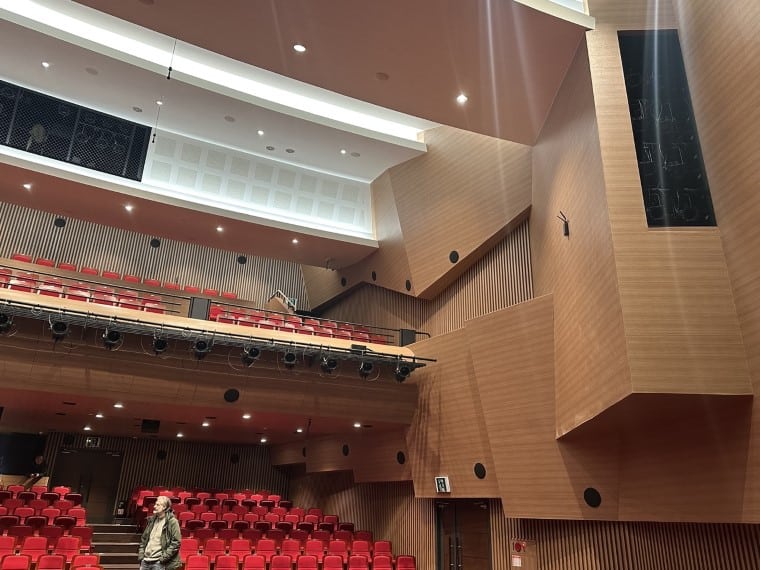
Theater aan de Parade – The Netherlands – equipped with SIAP Active Acoustics
What can SIAP Active Acoustics do for your venue?
SIAP Active Acoustics is designed to improve how a room performs in practice.
A venue that needs clarity for speech does not have to remain acoustically dry when music is scheduled. A hall designed for musical performance does not have to compromise speech intelligibility or amplified events.
With a properly designed active acoustic system, one physical room can provide several distinct acoustic environments.
Depending on the venue and application, SIAP Active Acoustics can:
- increase or reduce perceived reverberation
- enhance spaciousness and envelopment
- improve acoustic support for performers
- create suitable acoustic conditions for different music genres
- maintain clarity for speech and amplified events
- increase the perceived acoustic volume of a room
- turn a single-purpose room into a genuinely multipurpose venue
These acoustic conditions can be stored as presets and recalled instantly.
Designed around the room
Every room is different.
Its volume, geometry, natural reverberation, architectural finishes, audience capacity and intended use all influence how an active acoustic system should be designed.
For this reason, SIAP does not start with a fixed loudspeaker or microphone package.
The number, type and distribution of microphones and loudspeakers are determined specifically for each project, based on:
- room volume and geometry
- existing passive acoustics
- acoustic objectives
- required sound-field uniformity
- programme and venue use
- architectural integration
- available infrastructure
- project budget
This allows the system to be optimised for both acoustic performance and project requirements.
A larger number of distributed loudspeakers can, for example, create a denser and more uniform acoustic field in larger spaces. In other situations, a more compact configuration may provide the required result.
The objective is not to maximise hardware, but to use the right system architecture for the room.
More than reverberation - creating acoustic volume
One of the most important capabilities of active acoustics is the ability to influence how large a room feels acoustically.
A physical room has a fixed volume, but its perceived acoustic volume can be changed.
By carefully controlling the relationship between early energy, reverberation, spatial distribution and acoustic support, an active acoustic system can allow a relatively compact venue to behave more like a larger acoustic environment.
This is particularly valuable for orchestral music, brass bands and other powerful acoustic ensembles.
Instead of simply increasing reverberation time – which can also increase perceived loudness and reduce clarity – the system can create greater spaciousness and acoustic support while maintaining controlled sound levels.
For multipurpose halls, this makes it possible to combine acoustic conditions that would otherwise require very different room volumes or extensive mechanical acoustic treatment.
How Does SIAP Active Acoustics Work?
SIAP Active Acoustics uses microphones, real-time digital processing and distributed loudspeakers to capture, shape and redistribute acoustic energy throughout the venue.
The system works with the sound already present in the room.
Microphones capture the acoustic field, the SIAP processing platform analyses and shapes this information in real time, and the resulting sound is returned through carefully positioned loudspeakers.
This interaction allows the acoustic behaviour of the venue to be influenced while maintaining a natural relationship between the performers, the room and the audience.
The system can affect acoustic qualities including:
- reverberation
- clarity
- diffusion
- spaciousness
- envelopment
- acoustic support
- perceived room volume
The result is not simply an electronic effect added to the programme signal, but an acoustic environment that becomes part of the room itself.
Three main approaches to active acoustics
In scientific literature, active acoustic systems are also commonly referred to as Active Acoustic Enhancement Systems (AAES). Other terms, such as electronic acoustic enhancement and electronic architecture, are also used within the field.
There are several ways to create active acoustic enhancement.
In-line systems
Inline systems capture sound, process it, and return it to the space without creating a feedback loop. This offers precise control over the acoustic result and allows detailed adjustment of system behaviour.
Regenerative systems
Regenerative systems use a controlled feedback relationship between microphones and loudspeakers to build on the room’s natural acoustic energy. This can create a highly natural result, but system stability and the characteristics of the existing room become particularly important.
Hybrid systems
Hybrid systems combine regenerative and in-line processing. This allows the natural interaction of regenerative acoustics to be combined with the precision and flexibility of digital processing. The principle may sound simple, but the acoustic result depends strongly on how these two domains are combined, controlled and tuned.
See Active Acoustics in Action
Why SIAP takes a hybrid approach
SIAP has developed a proprietary hybrid operating principle in which regenerative acoustics and in-line processing operate together as one coherent acoustic system.
The regenerative and in-line domains are not treated as independent domains.
Their interaction is designed and tuned around:
- the natural behaviour of the room
- microphone and loudspeaker distribution
- acoustic stability
- the intended programme
- the required acoustic response
This allows SIAP to control reverberation, acoustic support, spatial impression and perceived room volume while maintaining a natural connection between the electronically enhanced field and the physical room.
The goal is not to make listeners hear an acoustic effect.
The goal is for the room itself to feel acoustically different.
This is a key part of what distinguishes SIAP Active Acoustics and helps create a natural acoustic result across different room conditions.
What makes SIAP different?
SIAP approaches Active Acoustics first and foremost as an acoustic design discipline.
Technology is important, but the final result depends equally on understanding the room, selecting the correct system architecture, integrating the components and tuning the completed installation.
What distinguishes SIAP Active Acoustics:
- Proprietary hybrid operating principle
- Natural acoustic enhancement
- Project-specific room-based system design
- Distributed sound-field design
- Acoustic expertise combined with musical sensitivity
- Brand-agnostic hardware integration
- Open architecture without a closed loudspeaker or amplifier ecosystem
- Automatic speech clarity control
- Scalable solutions for different venue sizes
- Specialist system design and on-site tuning
- Decades of experience in active acoustics
- More than 80 installations worldwide
SIAP has worked with active acoustic systems since the late 1980s.
That experience is reflected not only in the processing technology, but also in the acoustic design methodology used to determine where microphones and loudspeakers should be positioned, how much acoustic gain is appropriate, and how the system should interact with the passive room.
The system is only as good as its design and tuning
Active acoustics cannot be reduced to a processor specification.
The quality of the result depends on the complete electro-acoustic system.
This includes:
- passive room acoustics
- microphone characteristics and positioning
- loudspeaker directivity and distribution
- system gain structure
- signal processing
- delay relationships
- frequency response
- system stability
- acoustic presets
- final tuning
SIAP therefore works closely with acoustic consultants, architects, system integrators and venue teams throughout the project.
During commissioning, the completed system is measured and tuned in the actual venue.
Presets are then created for the required applications, allowing staff to recall complex acoustic conditions through a simple control interface.
Brand-agnostic and open by design
SIAP is not dependent on a proprietary loudspeaker, microphone or amplifier ecosystem.
The AVA processing platform can be integrated with suitable professional equipment from established manufacturers.
This gives consultants and system integrators greater flexibility when selecting equipment based on:
- acoustic requirements
- architectural constraints
- local availability
- existing infrastructure
- serviceability
- project budget
The result is an active acoustic solution designed around the venue rather than around a compulsory hardware package.
Active acoustics vs convolution-based approaches
Not every system that creates reverberation changes the acoustics of the room itself.
Convolution and impulse-response processing can make an individual source signal sound as though it belongs to a different acoustic environment. This can be useful for virtual acoustics, simulation and creative applications.
Active Acoustics addresses a different objective.
Instead of only processing individual source signals, SIAP Active Acoustics influences the acoustic environment experienced by performers and audiences throughout the room.
This distinction is important.
The purpose is not simply to reproduce the sound of another space through the sound system, but to change how the venue itself supports sound.
One venue - multiple acoustic environments
A SIAP system can provide different acoustic presets for different types of use.
Typical examples include:
Amplified music
A controlled, lively acoustic response that supports the reinforcement system without excessive reverberation.
Speech
Enhanced early acoustic support with controlled reverberation for clear and intelligible speech.
Theatre
Controlled acoustic support while maintaining localisation and speech intelligibility.
Opera
A balanced acoustic environment that supports singers and orchestra, combining clarity, projection, warmth and spatial support.
Solo recital – piano and acoustic instruments
Natural clarity, intimacy and acoustic support, carefully balanced for the character and dynamics of the instrument.
Brass band and powerful acoustic music
Increased spaciousness and acoustic support while maintaining controlled sound levels for powerful acoustic ensembles.
Chamber music
Greater warmth, reverberation and ensemble support while preserving definition and musical detail.
Small orchestra
Increased reverberation and spaciousness with natural ensemble support, while maintaining clarity and musical definition.
Large orchestra
A more expansive acoustic environment with longer reverberation, increased spaciousness and greater perceived acoustic volume.
Choir
Enhanced reverberation, envelopment and acoustic support, helping singers feel supported by the room while maintaining connection with the ensemble.
Traditional and culturally specific music
Custom acoustic environments can be developed for particular musical traditions and performance styles, where the desired balance of clarity, reverberation, intimacy and spatial response may differ from conventional concert settings.
These are not fixed templates. During commissioning, SIAP develops and tunes the acoustic environments around the venue, its programme and the needs of performers and audiences.
These presets are recalled from a simple user interface, allowing the venue to change acoustic character instantly.
Proven in real venues
SIAP Active Acoustics is used in theatres, concert halls, auditoriums, schools, rehearsal venues and multipurpose spaces internationally.
Each project presents a different acoustic challenge.
Some venues require significant changes in reverberation time. Others require additional spatial support, improved performer conditions or the ability to accommodate both amplified and unamplified events in the same room.
What remains consistent is the design philosophy:
understand the room first, define the acoustic objective and then design the system required to achieve it.

Natural RT 1,2s

Natural RT 1,0s
Natural RT 0,9s
SIAP AVA - the platform behind the system
SIAP Active Acoustics is powered by the AVA processing platform.
AVA provides the real-time processing, routing and system control required for advanced active acoustic installations and can be configured for projects of different sizes and complexity.
The system architecture supports integration with professional audio networks and third-party equipment while maintaining a single acoustic control environment.

Working with consultants and system integrators
SIAP regularly works as part of a wider project team.
We support acoustic consultants, AV consultants, system integrators, architects and venue operators during:
- concept development
- system design
- acoustic modelling and evaluation
- loudspeaker and microphone layout
- equipment selection
- integration engineering
- commissioning
- measurement
- acoustic tuning
- operator training
Our role can therefore range from specialist active-acoustics supplier to an integrated part of the acoustic design team.
If you are developing a project and want to evaluate whether Active Acoustics is appropriate, SIAP can review the room geometry, passive acoustic design and intended programme at an early stage.
Suitable for many spaces
SIAP Active Acoustics can be applied to:
- theaters
- auditoriums
- concert halls
- rehearsal spaces
- places of worship
- hospitality venues
- selected outdoor applications
- multi-use venues
The appropriate system architecture depends on the venue.
There is no single standard configuration.
Frequently asked questions
What is Active Acoustics?
Active Acoustics uses microphones, real-time digital processing and distributed loudspeakers to modify the acoustic behaviour of a room.
It allows a venue to provide different acoustic environments for different uses without physically changing the room.
How does Active Acoustics benefit my venue?
Active Acoustics allows one venue to support very different programme requirements – from speech and amplified events to theatre, solo recitals, chamber music and orchestral performance.
Acoustic conditions can be adapted to provide the appropriate balance of clarity, reverberation, spaciousness and acoustic support for each use.
Does Active Acoustics only change reverberation time?
No. Reverberation time is only one aspect of the acoustic experience.
A well-designed Active Acoustic system can also influence clarity, spaciousness, envelopment, acoustic support and perceived acoustic volume.
Does active acoustics sound natural?
Yes. When properly designed and tuned, the electronic system should not be perceived as a separate sound source or effect.
The objective is for performers and audiences to experience the room itself as having a different acoustic character.
Can one room support both speech and music?
Yes. This is one of the main reasons for using Active Acoustics in multipurpose venues.
For speech, the system can provide enhanced early acoustic support with controlled reverberation for clarity and intelligibility. For music, it can create greater reverberation, spaciousness, envelopment and acoustic support.
Different acoustic environments can be stored as presets and recalled instantly.
Is Active Acoustics suitable for different venue sizes?
Yes. Active Acoustic systems can be designed for spaces ranging from rehearsal rooms and smaller auditoriums to theatres, multipurpose halls and large concert venues.
The appropriate system architecture depends on the room, its natural acoustics and the required acoustic performance.
How many microphones and loudspeakers are required?
There is no fixed number.
The quantity, type and distribution of microphones and loudspeakers are determined by the room volume and geometry, existing acoustics, required sound-field uniformity, intended use and acoustic objectives.
SIAP therefore designs each system specifically for the venue rather than using a fixed hardware configuration.
Why does SIAP use time-invariant processing?
SIAP uses a proprietary time-invariant processing principle, originally developed and patented in the 1990s. Unlike approaches that rely on frequency shifting or time modulation, SIAP achieves the required system stability without continuously altering the signal in time or frequency.
This helps preserve the natural character of the original sound, which is particularly important for critical musical sources such as piano and acoustic ensembles.
What makes SIAP different from other Active Acoustic systems?
SIAP brings together acousticians, musicians and technical experts – combining acoustic science, engineering and musical sensitivity in the way we design and tune our systems.
This multidisciplinary approach, together with our proprietary hybrid operating principle and project-specific design philosophy, allows us to consider each venue from both a technical and musical perspective. The result is an Active Acoustic system designed around the room and how it should ultimately sound and feel.
Explore FURTHER
Looking for more technical detail? Explore our technology, system documentation, white papers and project case studies.
Explore more:
Discuss your project with SIAP
Active Acoustics works best when it is considered early in the acoustic and AV design process.
If you are designing a theatre, auditorium, concert hall or multipurpose venue, we can review the room, its natural acoustics and its intended uses and help determine an appropriate system concept.
Talk to SIAP about your project.
Contact us today to learn how SIAP can transform your space.
Newsletter
Subscribe to our newsletter for exclusive insights into our latest projects, acoustic innovations, and upcoming events! Be the first to hear about demonstration opportunities, from intimate spaces to large venues, where you can experience the SIAP difference firsthand. Join our community today and stay connected with everything happening at SIAP!


